The evening began with a keynote by Prof. Jürgen Richt of Kansas State University, a leading figure in veterinary medicine and an expert in the „One Health“ approach. As a member of the Leibniz Lab’s scientific advisory board, he addressed a pressing topic: Bird flu in cattle and the susceptibility of livestock to H5N1 infections..
Over the course of an hour, Richt outlined the risks and mechanisms of transmission — and the challenges these pose for public health. He then broadened the discussion, reflecting on the current climate for science in the United States. What became clear throughout his lecture, and again in the following workshop, is that science never unfolds in isolation. It relies on exchange — between researchers, and just as importantly, with society. Each shapes the other in a continuous dialogue, even if this interdependence is not always immediately visible.
Science thrives on dialogue.
The COVID-19 pandemic showed how destructive it can be when competing ideas, narratives, and institutions collide — not only in medicine, but also in the public perception of the crisis. Preparing for the next pandemic will require shared responsibility and cooperation, so that subjective viewpoints do not obscure objective reality. Understanding pandemics in full means looking beyond biology alone. Mathematics, history, and the social sciences all contribute important perspectives. Yet the way science is currently organized often works against such a holistic view — and that’s before the political dimension even enters the picture.

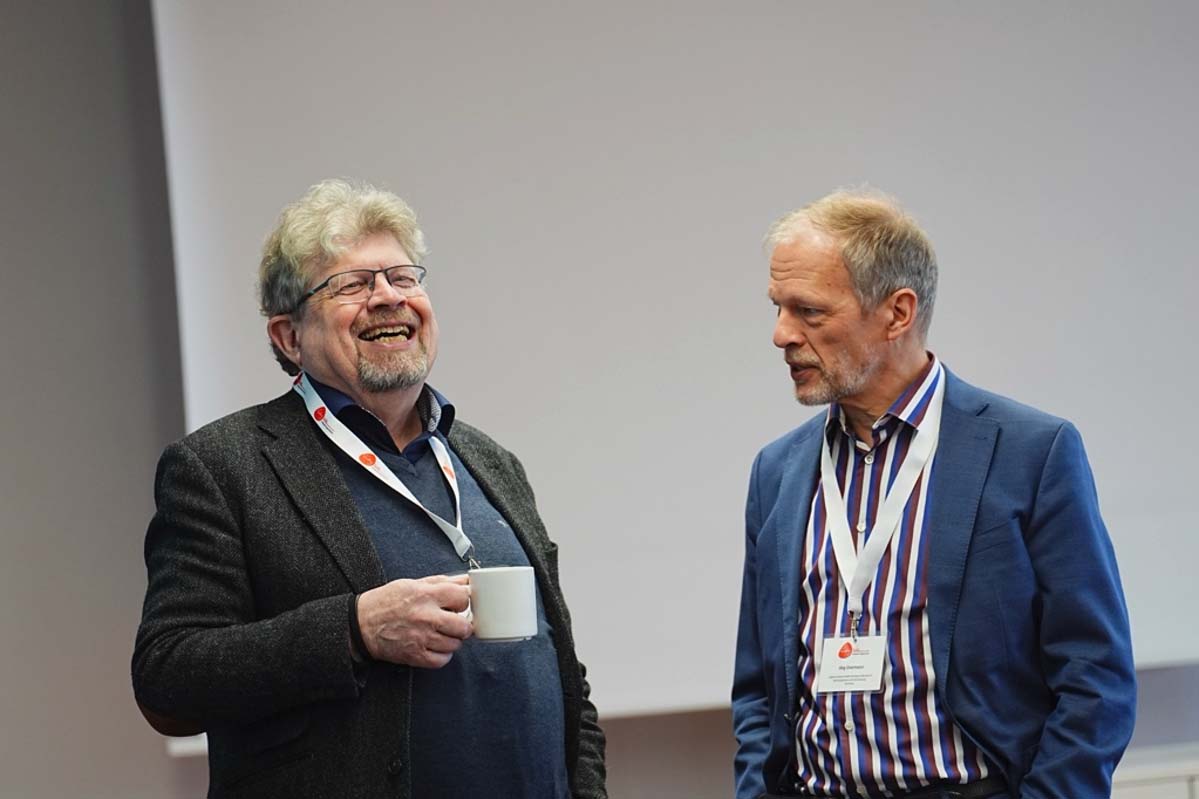
One-to-one communication is key: Markus Huff of the Leibniz Institute for Knowledge Media in Tübingen exchanged ideas with Angelina Böhnisch, also from Tübingen, who contributes to Working Package 7 at the Leibniz Lab.
This not only undermines effective prevention and response but can also frustrate the general public. After all, it is possible to study virus evolution, develop curricula, and circulate ideas — yet still overlook the political implications.
The collegial discussions, horizontal communication, and exchange of ideas fostered by the Leibniz Lab Pandemic Preparedness represent a new kind of science — one that connects expertise with collaboration and real-world impact.
The Four Focal Areas
Ongoing work across the Leibniz Lab’s four research focal areas was highlighted during the event. In the Human-Animal-Environment Interphase focal area, Work Package 1 focuses on the early detection of novel pathogens. Existing biodiversity monitoring measures and platforms will be analyzed to evaluate their potential for more efficient use. Work Package 2 examines the risks associated with livestock farming, exploring targeted interventions — particularly in stable design — to reduce infection risk while also improving animal welfare.
The Disease Burden focal area was also featured in the workshop. Work Package 3 assesses existing immunity in the population against H5N1, a virus considered potentially relevant for future pandemics. Work Package 4 investigates this virus’s ability to replicate in fat cells and explores possible drug interventions. Mental health, addressed in Work Package 6, focuses on protective and risk factors for psychological resilience during epidemics and pandemics, with special attention to vulnerable groups such as children, adolescents, and people with lower education or income levels. Finally, Science Communication is the focus of Work Package 7, which evaluates strategies for building research infrastructure to support evidence-based communication within the Leibniz Lab.

The programme was both exciting and multifaceted.
Halfway through the day, it was already apparent that the insights gained would provide a foundation for sustainable, evidence-based pandemic prevention. After the break, attention shifted to pandemic management. Work Package 8 examines the socio-economic and health factors that affect the likelihood of COVID-19 infection, including pre-existing conditions, lifestyle, and regional differences between urban and rural areas.
While the topic may seem to be irrelevant for anyone outside of the scientific bubble, understanding the last pandemic is crucial for improving our response to the next one. Work Package 10 explores the potential content of a global pandemic treaty and the political processes required to develop it, presenting the first results of this work.

Klaus Lieb from the Leibniz Institute for Resilience Research in Mainz also presented initial findings.
The fourth focus area, Pandemic-Resilient Education Systems, looks at how we can strengthen schools and universities to better withstand future health crises. Within this area, Work Package 12 develops strategies to support the mental resilience of both students and teachers, ensuring that learning can continue even under challenging conditions. The day concluded with a lecture by Prof. Achim Wambach from the Leibniz Centre for European Economic Research in Mannheim. He discussed how scientific evidence can be translated into political action—and the hurdles that often stand in the way of truly evidence-based policies.
